Who will win the epic battle of cool dad bikes? The BMW Motorrad R1200GS, or the Moto Guzzi Stelvio 1200? Oh yeah, you haven’t heard of the Stelvio. That’s okay. The new Euro 4 standards recently shelved production, but I think it’s still worth a look. The Stelvio is a beautiful machine handmade in Moto Guzzi’s century old factory in Mandello del Lario, Italy. Although similar in design to the German dual sport, it has a personality all of its own, and that for less money. Disclaimer: I really liked it.
I think the R1200GS is a pretty good backboard for an adventure bike review since it really does lead the class in terms of sales and sheer sophistication and polish. With that in mind, I rode a Stelvio through the winding roads of Southern California’s San Gabriel Mountains. I began my ride mid-morning, with Mt. San Antonio in my cross-hairs.

The air-cooled 1200cc transverse V-twin engine rumbled to life with just under a second of hesitation. It quietly gulped in the dense morning air without audibly complaining. Straddling the bike doesn’t immediately strike you the way it’s German counterpart does. This was also true of Guzzi’s V7 (more on that bike here). It took me a minimum of 30 minutes to get in touch with the V7 when I rode it, so I was expecting the same experience with the Stelvio. This strange phenomenon is, I think, a reason why most dealership test riders are not impressed by Moto Guzzi.

As I cruised up the broad but perfectly winding canyon, palpably sensing my departure from the syrupy layer of cold valley air, I began to get that blessed feeling. A smile jutted across my face and I felt tingly down to my toes. I had just gotten in touch with the bike, found it’s grove, clicked. We are friends now.

It’s a strange thing to describe. While the BMW immediately imbues its rider with a rather dazzling sense of smug, polished satisfaction, the Italian bike filled me with a warm, bubbly sense of happiness. For some reason, the Stelvio felt like it was truly mine. The BMW feels like you are riding their creation, courtesy of your money. The Stelvio feels more like a magic elf that found it’s way to you, immediately became obsessively attached, and the money you paid for it was but a nominal fee, to be forgotten.


As I wound through the high speed corners, I found myself in 6th gear almost immediately and permanently. At first, I was puzzled by this apparent comfort zone. I knew the engine had more to offer, but it was just so happy to lope it’s way up the hill that I just left it there. The bike insisted that two-lane canyon roads are meant for fast, yet relaxed riding. After a mild protest, I realized it was right. The views were really stunning anyway, and the road easy enough to look at them. Besides, the bike is really so angelic at falling into hard banks, I was genuinely surprised the first time I dragged a toe.
A few small flaws showed up as I rode. The front brake on this particular specimen had some initial slop that was mildly unsettling. Neutral tends get lost in the woods, but is never too far away. The factory fairing vibrates with the engine, sending rippling air past your helmet at higher speeds. Annoying on the freeway. The more discerning butt may at times sense some rightward torque-over from the transverse twin, but this is no more relevant than on a BMW.


The roughest edge on this bike during this ride was actually something that apparently only plagues new Stelvio’s. From exactly 3500-4000 rpm, there is a strong, pervasive, buzzing vibration. This is a very inconvenient rev-range to have such a vibration. That being said, there are two saving graces. One, the engine is always above this range in 6th gear on a freeway at 65+ MPH. Two, the low end torque on this engine is so juicy, there are plenty of rpm options above and below that range. Besides, I could swear I felt this issue dissipating even within the 80 miles I logged in the day.
In terms of design, the Stelvio is quite an interesting bike. It is a large-bore V-twin in a sexy European adventure touring motorcycle. Despite it’s geometry, the engine is revving, capable and dynamic. It really scoots along when you manage to get it up into the second exhaust outlet. As far as I could tell, by the way, this is actuated mechanically/aerodynamically as supposed to BMW’s electronic dynamic exhaust. Lots of things that are electronic, fly-by-wire, liquid cooled, or laser cut on the R1200GS are not on the Stelvio.
This capable personality is interesting because the engine is essentially designed to defy it’s own nature. Similar American V-twins are generally not known for versatility (other than loping comfortably down the freeway). Something about the firing interval, internal porting, and who-knows-what else, makes this engine a real hero. I had no problem jetting up the intense hairpins of my favorite connector road in low gears.
I wouldn’t describe the bike as ‘flick-able’, but it handled the road with ease and grace nonetheless.

As I headed up toward Mt. San Antonio, I was quite proud and continually satisfied with the Stelvio. It was happy too. Our conversation had reached that point when new friends run out of things to talk about and just walk in silence for a little while. The Stelvio was home on these roads. Named after the Stelvio Pass in norther Italy, the tight turns and 7000 ft elevation gain of the day’s ride were designed into it’s very genome.
Finally, I reached my intended destination.
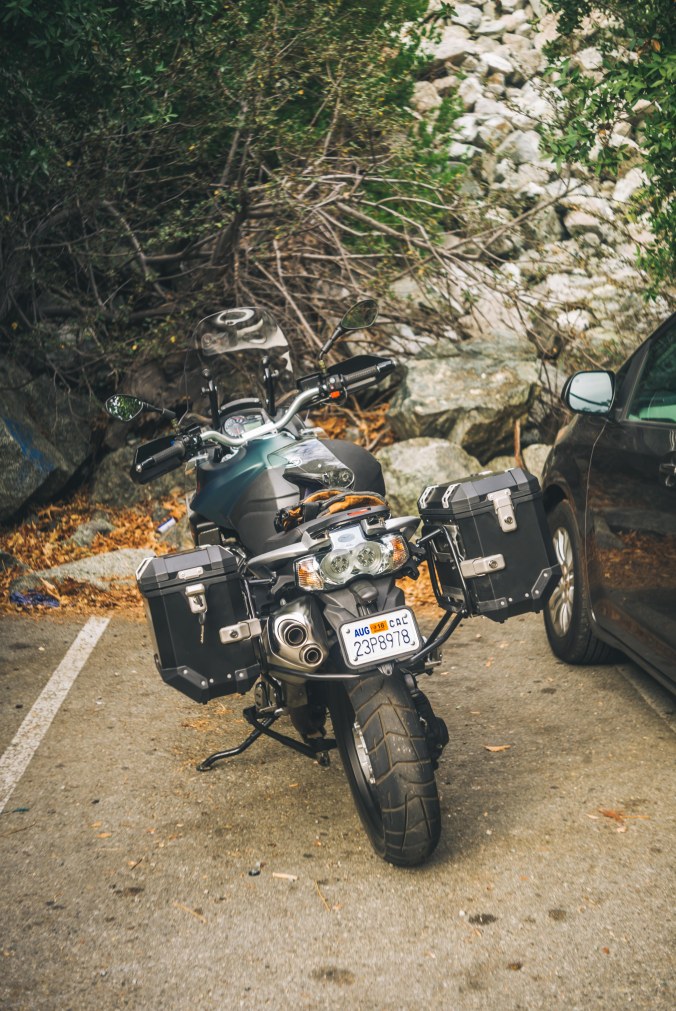
Kickstand down.
Legs relax.
Engine burbles into silence.
Bra (helmet) off.
Piercing mountain air flows through soul.
Calm.

As I rumbled down Mt. San Antonio the ‘fast way’ and merged onto the freeway, I was immediately aware of the bike’s inherent stability at high speeds. I felt as though I was setting the land speed record for a bank vault. I gave the handlebars a telling high-speed wiggle. Nothing. The R1200GS is pretty stable as well, but even it had a twinge of feedback when faced with the same query. The Stelvio did wiggle some, but only insofar as I had directed it to in terms of actual steering. No feedback wiggle. Amazing.
Let me begin my conclusion by saying that I am a huge fan of the BMW R1200GS and the boxer engine bikes in general. Their legacy, on and off road, is phenomenal, and the Germans’ most recent additions to the adventure touring category are polished and sophisticated on a stratospheric level.
That being said, the Stelvio is 95%+ of what a GS is in those terms. Almost every review online actually has the Guzzi beating the BMW at blacktop riding. That is entirely half of what an adventure touring bike is. On the trail, they are nearly even. To top it off, you will never see another one passing you on the road. Personally, I think that counts for something.
If I come off as a bit defensive, it is because the elusive smile-factor of the Stelvio is (in my opinion) of higher quality than that of the R1200GS. The problem is: it is and will always be completely lost during a back-to-back road review against a similar bike. It doesn’t impress on paper. It doesn’t dazzle reviewers; but I promise it will satisfy owners.
At the end of the day, one bike isn’t necessarily better than the other. The BMW thing will appeal to some, the Moto Guzzi thing to others. The Moto Guzzi is a conversation piece. If you like bikes that make you smile and either value or are OK with a more mechanical feel, the Stelvio is your adventure bike. If you love the feel of Germanic engineering and knowing that you have the superior bike in almost every situation, the BMW is for you. Even still, no one will walk up and ask you about it. It’s up to you.
Convenient stats for the uninformed:
- 1151 cc; air-cooled ///
- 103 hp @ 7520 rpm ///
- 83 lb·ft @ 5800 RPM ///
- 618 lbs; with stock panniers ///
- 8.5 gal fuel capacity ///
- 1170 cc; liquid-cooled ///
- 123 hp @ 7,750 rpm ///
- 92 lbf·ft @ 6,500 rpm ///
- 525 lb; without optional panniers ///
- 5.3 gal fuel capacity ///
 The Bardo